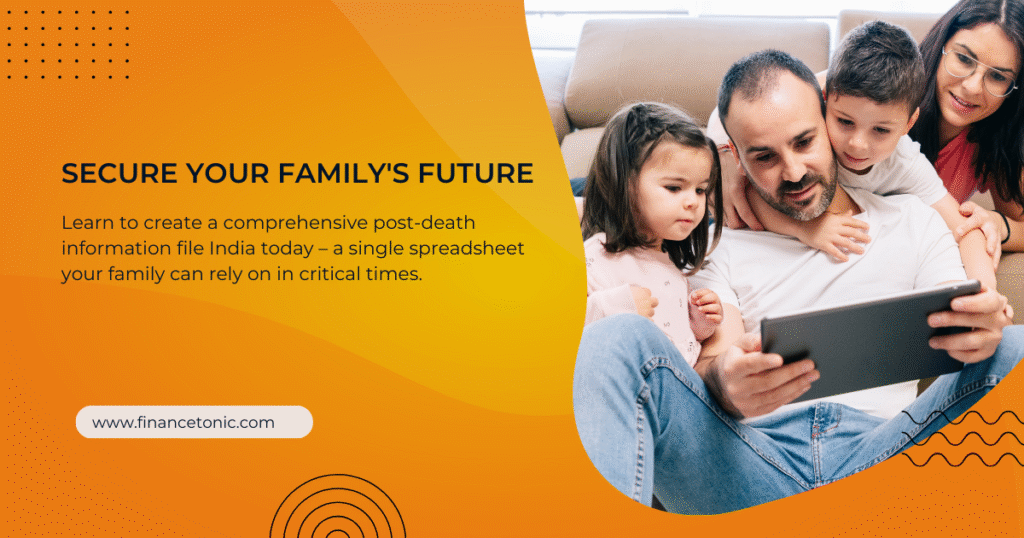
In life’s unpredictable journey, preparing for the inevitable is the kindest gift you can offer your family. Imagine a scenario where, in your absence, your loved ones are left navigating a maze of bank accounts, investments, insurance policies, and bills, all while grappling with grief. This isn’t just a hypothetical nightmare; it’s a common reality for countless Indian families. The solution? A meticulously crafted post-death information file India – a single, accessible document that acts as a financial compass during their most vulnerable time. It’s not about dwelling on the future, but empowering your family with clarity and control, ensuring your hard-earned legacy is managed with ease, not despair. Let’s create this vital safeguard, starting today.
The Hidden Chaos: Why a Post-Death Information File is Essential for Indian Families
A comprehensive post-death information file India is not a luxury; it is a fundamental necessity in today’s complex financial world. In the immediate aftermath of a loss, families are overwhelmed by emotion. The last thing they need is the added burden of a financial treasure hunt, piecing together a lifetime of scattered assets and liabilities without a map.
In the Indian context, this chaos is often magnified. Financial lives are frequently intertwined within families, but documentation can be informal or outdated. Investments might have been made decades ago, with physical share certificates tucked away in forgotten places. Passwords to critical online portals, from net banking to mutual fund dashboards, might have been known only to the deceased.
This lack of a central information source leads to significant problems. Assets worth crores of rupees lie unclaimed with banks, insurance companies, and the Employees’ Provident Fund Organisation (EPFO) simply because heirs are unaware of their existence or don’t have the necessary details to stake a claim. Without clear instructions, families can miss crucial deadlines for claims, face difficulties in transferring ownership of properties, and even become vulnerable to financial fraud.
Moreover, the absence of a consolidated file can fuel family disputes. Ambiguity over assets, the location of a Will, or the details of a loan can create misunderstandings and strain relationships at a time when unity is most needed. Creating a clear, organized post-death information file India is therefore an act of profound love and responsibility. It replaces confusion with clarity, anxiety with assurance, and potential conflict with a smooth transition, allowing your family to focus on healing rather than paperwork.
What to Include: The Comprehensive Checklist for Your Family’s Financial Blueprint
Your post-death information file India should be a one-stop repository of every critical piece of information your family will need. The goal is to leave no question unanswered. Organize your file into clear sections, either in a physical binder with labeled dividers or in a securely encrypted digital folder.
1. Personal and Legal Documents
This section contains the keys to your official identity. Include copies (and mention the location of the originals) of:
- Aadhaar Card and PAN Card (the two most critical documents for any financial process in India).
- Passport, Driving License, and Voter ID.
- Birth Certificate and Marriage Certificate.
- The original Will, along with the contact details of the lawyer who drafted it and the witnesses.
- Any trust documents or power of attorney papers.
2. Banking and Financial Accounts
Detail every account that holds your liquid assets. This prevents money from being left unclaimed.
- List of all Savings, Current, and Salary accounts with bank names, branch addresses, and account numbers.
- Details of all Fixed Deposits (FDs) and Recurring Deposits (RDs), including maturity dates and nominee information.
- Bank locker details: bank, branch, locker number, and location of the key.
- Information on any safe deposit boxes or other secure storage.
3. Investments Portfolio
Your investments are a core part of your legacy. Document them meticulously.
- Demat Account details (DP ID, Client ID) with the respective brokerage firms.
- List of all Mutual Fund folios, including the Asset Management Company (AMC) name and folio numbers.
- Provident Fund details: EPF account number (UAN), and Public Provident Fund (PPF) account number and branch.
- National Pension System (NPS) PRAN (Permanent Retirement Account Number).
- Details of any other investments like company stocks, bonds, National Savings Certificates (NSC), or Post Office schemes.
4. Insurance Policies
Insurance is a safety net you’ve built for your family. Ensure they can access it.
- Life Insurance Policies: Company, policy number, sum assured, and nominated beneficiary.
- Health Insurance Policy: Details for all family members, policy number, and contact for claims.
- Vehicle and Property Insurance: Policy numbers and coverage details.
5. Liabilities and Loans
Being transparent about debts is as important as listing assets.
- Details of any outstanding loans: Home loan, car loan, personal loan, with the lender’s name and account number.
- List of all active credit cards, including the card number and issuing bank. This is vital for closing the accounts and preventing misuse.
6. Digital Life and Passwords
In the modern age, our digital footprint is vast. This is a crucial, often overlooked, part of a post-death information file India.
- A secure list of important usernames and passwords. Consider using a password manager and providing instructions for the master password to a trusted individual.
- List of email accounts, social media profiles (with instructions on memorializing or deleting them), and any online subscriptions.
Step-by-Step Guide: Building Your Post-Death File with Indian Specifics (Aadhaar, PAN, Nominees)
Creating your post-death information file India is a systematic process that transforms a daunting task into a manageable project. Follow these steps to build a robust and actionable guide for your loved ones.
Step 1: Choose Your Format – Physical or Digital
Decide whether you prefer a physical “In Case of Emergency” binder or a secure digital vault. A physical file is simple and accessible, while a digital file (stored on an encrypted USB drive or secure cloud service) is easy to update and duplicate. Many people opt for a hybrid approach—a physical file with key documents and a master list that points to digital records.
Step 2: Gather and Organize Documents
Go through the comprehensive checklist from the previous section. Methodically collect photocopies of all required documents. Create a master spreadsheet or document that lists every account, policy, and asset with all the necessary details. This master list is the heart of your post-death information file India.
Step 3: Emphasize Aadhaar and PAN
In India, almost every financial transaction and claim process is linked to Aadhaar and PAN. Ensure these numbers are listed clearly at the very beginning of your file. Mention if your Aadhaar is linked to your mobile number and bank accounts, as this is crucial for OTP-based verifications that your family might need to handle.
Step 4: Understand and Align Nominees and Your Will
This is one of the most critical and misunderstood aspects of estate planning in India. You must clearly state the following for your family:
- A Nominee is a Trustee: For most assets like bank accounts, shares, and mutual funds, the nominee is merely a custodian. Their job is to receive the assets and hold them in trust for the legal heirs.
- A Legal Heir is the True Owner: The legal heirs, as defined in your Will (or by succession laws if you don’t have a Will), are the ultimate owners of the assets.
- Align Them to Avoid Conflict: To prevent disputes, it is best practice to nominate the same person in your accounts who is also the beneficiary in your Will. Clearly document all nominee details for every single account and policy in your file. This clarity is a cornerstone of an effective post-death information file India.
Step 5: Appoint an Information Keeper
Your meticulously prepared file is useless if no one knows it exists or where to find it. You need to appoint at least one, preferably two, trusted individuals (like your spouse, an adult child, or a trusted sibling) as your “information keepers.” You do not need to share the file’s contents with them while you are alive, but they absolutely must know of its existence and its precise location.
The Cost of Delay: Key Deadlines, Consequences, and Peace of Mind
Procrastination in creating a post-death information file India carries a heavy price, paid not by you, but by your grieving family. The consequences of delay are not just financial; they are emotional, legal, and deeply stressful. Understanding the tangible costs can provide the motivation needed to act today.
The financial world operates on strict timelines. After a person’s passing, several clocks start ticking. Your family will need to navigate key deadlines, and without a guide, they may miss them, leading to severe complications:
- Insurance Claims: Insurance companies require intimation of death within a specific period. Delay can lead to extensive questioning and potential rejection of the claim, denying your family the financial protection you intended for them.
- Informing Financial Institutions: Banks, brokerage firms, and mutual fund houses must be officially informed. Until then, accounts are vulnerable to misuse. Delays in this process can freeze assets for prolonged periods.
- Filing Final Income Tax Return: A final tax return must be filed on behalf of the deceased. Missing this can result in penalties from the Income Tax Department.
- Loan and Credit Card EMIs: Creditors will not stop demanding payments. Without information on liabilities, your family might miss payments, hurting the family’s credit history and potentially leading to legal action.
The consequences extend beyond missed deadlines. Assets without clear documentation or known nominees can get locked in a complex legal process requiring succession certificates from a court, which is both time-consuming and expensive. This is the painful reality that a well-prepared post-death information file India helps to avoid.
Conversely, the benefit of having this file ready is immense: peace of mind. It is the profound knowledge that you have done everything in your power to shield your family from administrative chaos during their most vulnerable time. It transforms a legacy from a puzzle to be solved into a gift to be received, allowing your loved ones to move forward with financial stability and security.
Your Legacy: How to Maintain and Share Your Financial Continuity Plan
A post-death information file India is not a ‘set it and forget it’ document. It is a living file that must evolve with your life’s journey. Creating it is the first major step; maintaining it is what ensures its enduring value. A well-maintained file guarantees that the information your family receives is accurate, current, and truly helpful.
Set a recurring date in your calendar for a financial check-up. A good practice is to review and update your file once a year, perhaps around the time you file your taxes when all your financial data is already at hand. Additionally, you must update the file immediately after any major life event, such as:
- Marriage, divorce, or the passing of a spouse.
- The birth or adoption of a child.
- Buying or selling a significant asset, like a property or a vehicle.
- Starting a new major investment or closing an old one.
- Changing a nominee on any account or policy.
- Taking out a new loan or paying one off.
Sharing the plan is as critical as creating it. The key is to distinguish between sharing the file’s *location* and sharing its *contents*. While you are alive, your financial details should remain private. However, your chosen information keepers must know two things without fail: that the file exists, and exactly where to access it.
Discuss the location options. A fireproof safe at home is a good choice. A bank locker is also secure, but ensure your information keeper is a joint holder or nominee for the locker itself, otherwise, they will face a lengthy legal process to get it opened. For a digital file, provide the keeper with the location (e.g., “the red USB drive in my study drawer”) and a separate, sealed envelope containing the master password, to be opened only when necessary.
Ultimately, this file is more than just a collection of papers and passwords. It is a testament to your foresight, care, and love for your family. By creating, maintaining, and sharing your financial continuity plan, you ensure your legacy is one of empowerment and security. A thoughtfully prepared post-death information file India is the final, and perhaps most important, piece of your financial planning puzzle.